Basic principles
of classical Chinese medicine


Basic principles
of classical Chinese medicine

Traditional Chinese medicine, in all its diversity, is based on the exclusive basic principe about the energy circulation in the body, whose main method of regulation after nutrition, for thousands of years is Acupuncture.
The Classical Chinese Medicine, recognizes that health is more than the absence of disease and it has a unique capacity to maintain and enhance our potential for well-being and happiness. Classical Chinese Medicine is one of the oldest systems of medicine dating back almost 5000 years. The Taoist philosophers of that time were astute observers of nature and realized that the fundamental processes of the universe were a good basis for understanding life.
The most ancient texts arrived to us through the centuries are the Ling Shu ( The Spiritual Pivot) and the So Wen ( Fundamental questions), gathered under the title Nei Qing Huangdi consist in a the analysis of Man's place in the Universe, according the Taoist conceptions. The texts studies the seasonal’s changes, the skin complexion's variations, the subtleties of the pulse, the condition of the five organs, the five tastes, the six energies...It explains how to work with the needles and how to use moxa to reestablish the harmony between up and down , between in and out. The treatise is aiming to reconnect Man to Nature, studying the different aspects of Medicine, giving special attention to Acupuncture.
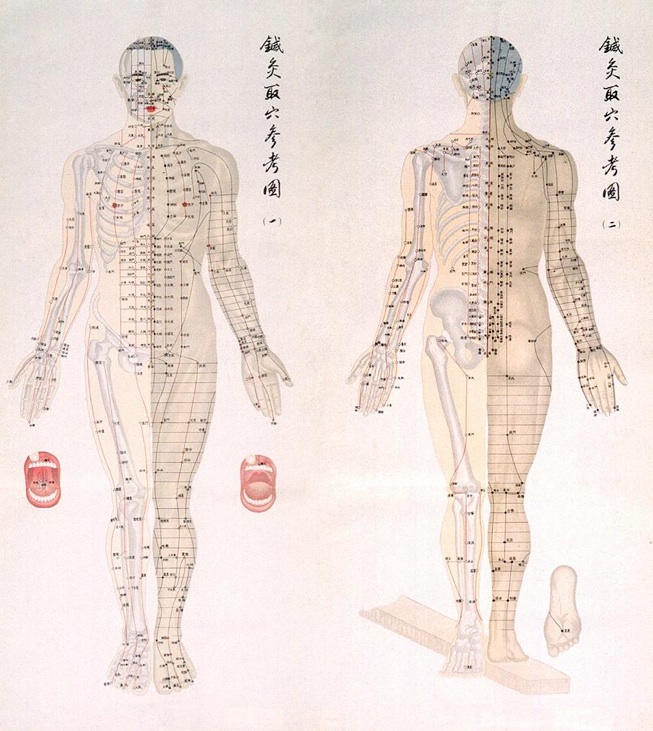
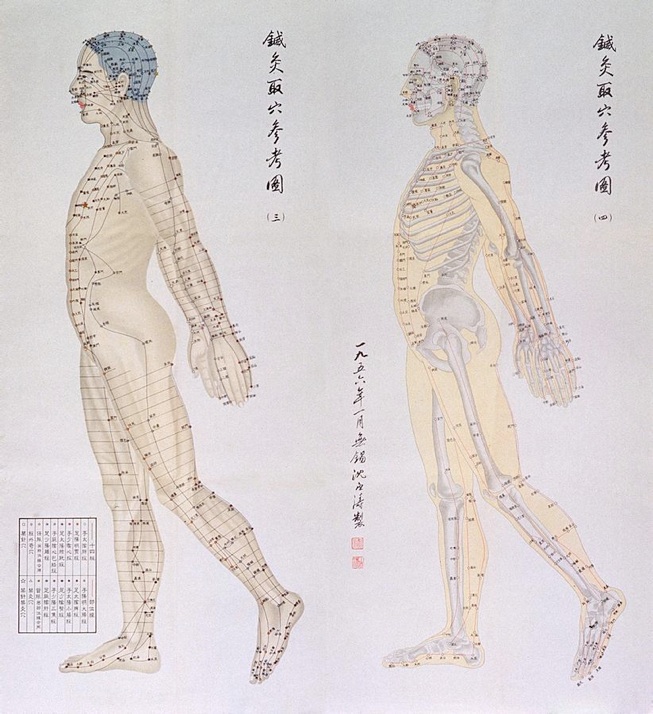
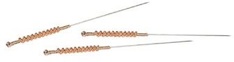
Acupuncture is the most well known therapy of oriental medicine. This method involves the insertion of fine needles into specific points on the body. These points lie along channels called meridians, within which flows energy (Chi).The meridians connect the inner organs with the surface of the body. The needling of points re-establishes balance within this organ-meridian system
The basic concept consists in the rebalancing of the energy to maintain health. This method is primarily a preventive one, but acupuncture also treats established energy imbalances preceding lesion stage. With lesion stage deals conventional medicine, also known as Western or Conventional Medicine.
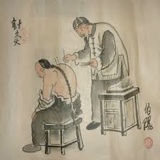
Except needling, to complete the healing effect of acupuncture, there are other techniques used like gua sha, cupping, moxa, “plum blossom” hammer and other.
The two main principles on which is based Acupuncture is Yin & Yang and the Five Elements. They allow a deep and holistic understanding of the energy processes in the Universe and their reflection on the human body, making acupuncture a real holistic medicine and energy science.
Yin & Yang
In Nature, everything we perceive with our 5 senses is the result of two fundamental principles. Everything in existence is made of the relationship between vibration and matter. Vibration or Energy is a masculine creative force, countered by matter, which is a feminine receptive force. Thus begins the principle of duality expressed in the Tao symbol.

We see this duality in ancient myths and philosophies. Yet only those philosophies and scriptures that were perverted and raped from the original meaning, giving the impression that one polarity was good and the other was evil. The original shamans, priest and sages thought, that both are necessary and one can not exist without the other. This two important principles come together to form all things in the Universe.
Yin and Yang are constantly opposing to each other, nevertheless they can not exist separately, because one of them is determining the other and vice versa.
Yin carries and nourishes the Yang, Yang covers and protects the Yin!
Yin: night, calm, dark, cold, woman, the blood, slow, inward, the Moon...
Yang: day, active, light, hot, man, the energy, fast, outward, the Sun...
Directions and Orientation
The observer standing in the center can determine 4 directions, corresponding to the 4 phases of Yin /Yang . Through observation, he notes many natural phenomena.
South is the area of the sun, the heat, the light, thus Yang.
North, on the contrary, is the zone of the cold, the darkness, the Yin .
East is the beginning of Yang, the rise of the sun, of the day start and the equilibrium point Yin = Yang, later which the Yang becomes predominant. Day replaces night.
West is the beginning of the Yin, the sunset , the end of Yang and the point equilibriumYin= Yang. Night replaces day .
Seasons
In the temporary-spatial relation, the Orients represent Space and the succession of the seasons represents the flow of time. They are the basis of all the mutations.
Yang seasons: Spring and Summer.
Yin seasons: Autumn and Winter.
The Chinese Tradition distinguishes another season, a fifth one, that corresponds to the Center -Earth and to the passage of the energy from one season to another, from one Element to another in a median period of 18 days. This is the time between two seasons, to which is added also August in the annual cycle, considered as a month belonging to the Earth Element.
The maxima of the energies Yin and Yang correspond to the summer and winter solstices (the longest day and the longest night) and to noon and to midnight of the day cycle
The moments of equilibrium Yin and Yang represent the spring and autumn equinoxes (day = night and night = day ) and to the periods of sunrise and sunset .
This is different from the western measure, where equinoxes and solstices mark the start of the season. In the Chinese system, these dates fall in the middle of the season.
So we distinguish:
5 periods : night , morning, noon , afternoon, evening.
5 directions : north, south, east, west , center.
5 seasons : winter , summer, spring , autumn, 5th season.
5 climate : cold , hot , windy , dry and wet.
These notions are in the base of the other Principle of Acupuncture, the Five Elements.
The Five Elements
According to 5 Element theory the energy of the world can be divided into 5 movements or phases. These interrelated aspects of energy are evident in nature as Water, Wood, Fire, Earth, and Metal and are in constant movement and connection with each other.
Through the associations made with the elements there arises a language to describe the world and a way to observe and determine the constitution of a person. There are many correspondences associated with each element, here is a brief outline pertaining to the 5 element diagnosis.
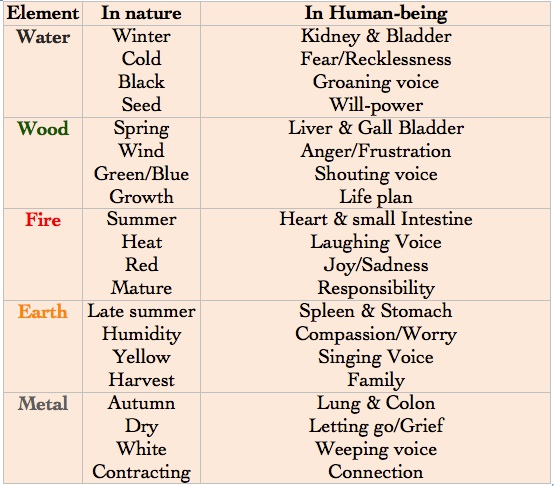
Each element describes a different phase in nature and in a person. How a person acts & goes about life reveals a lot about their inner state & also about the energy in their organs. A 5 element acupuncture diagnosis is about recognizing which phase is out of balance and treating the corresponding organ to regain balance.
The organs are not only limited to physical functions, but are responsible for our emotional and spiritual balance.
Each element has a unique character and they can be described as 5 Types.
Healthy organs give us capacity for healthy emotional expression
Water-Kidney: capacity to feel fear, sense & assess risk & respond appropriately.
Wood-Liver: capacity to to be assertive, have structures & boundaries enabling us to grow & develop
Fire-Heart:capacity to feel joy; give & receive warmth, love & varying degrees of emotional closeness.
Earth- Spleen:capacity to support & nourish ourselves and others appropriately
Metal-Lungs: capacity to feel loss and let go, ability to receive recognition and feel complete
Imbalance diminishes capacities associated with organ
Water-Kidney: frightened & not feeling safe "Can I trust"
Wood-Liver: anger, frustration "I don't know my direction ìn life"
Fire-Heart: hurt, abandonment, feeling rejected "I am unlovable"
Earth- Spleen:not being nourished, or supported "No-one looks after me"
Metal-Lungs: not recognized or acknowledged, feeling something is missing "I’m not good enough"
Wood corresponds to Spring, to germination period, to the beginning of plant growth, to the beginning of the year, to the birth of the day, so of life.
Fire corresponds to Summer, to the period of heat, to plant growth, to the half Yang of the year, to noon in the day cycle.
Earth corresponds to late summer, to the age of maturity.
Metal corresponds to Autumn, period of reduction of the vegetation, to harvest, to the year’s end, the end of the day.
Water corresponds to Winter, the age of cessation of the activities, to rest, to the disappearance of vegetation by burial . It's the end of the cycle, the night.
Earth is the central vitality, maintenance of the 4 other elements that Earth nourishes. Its seasonal location corresponds to the end of the summer because the vegetation is in full expression of its maturity , inherent product of the Earth’s nourishment . It is, by analogy, the food we ingest during the day.